Project Overview
The Delaware River Bridge: Planning for a Stronger Connection
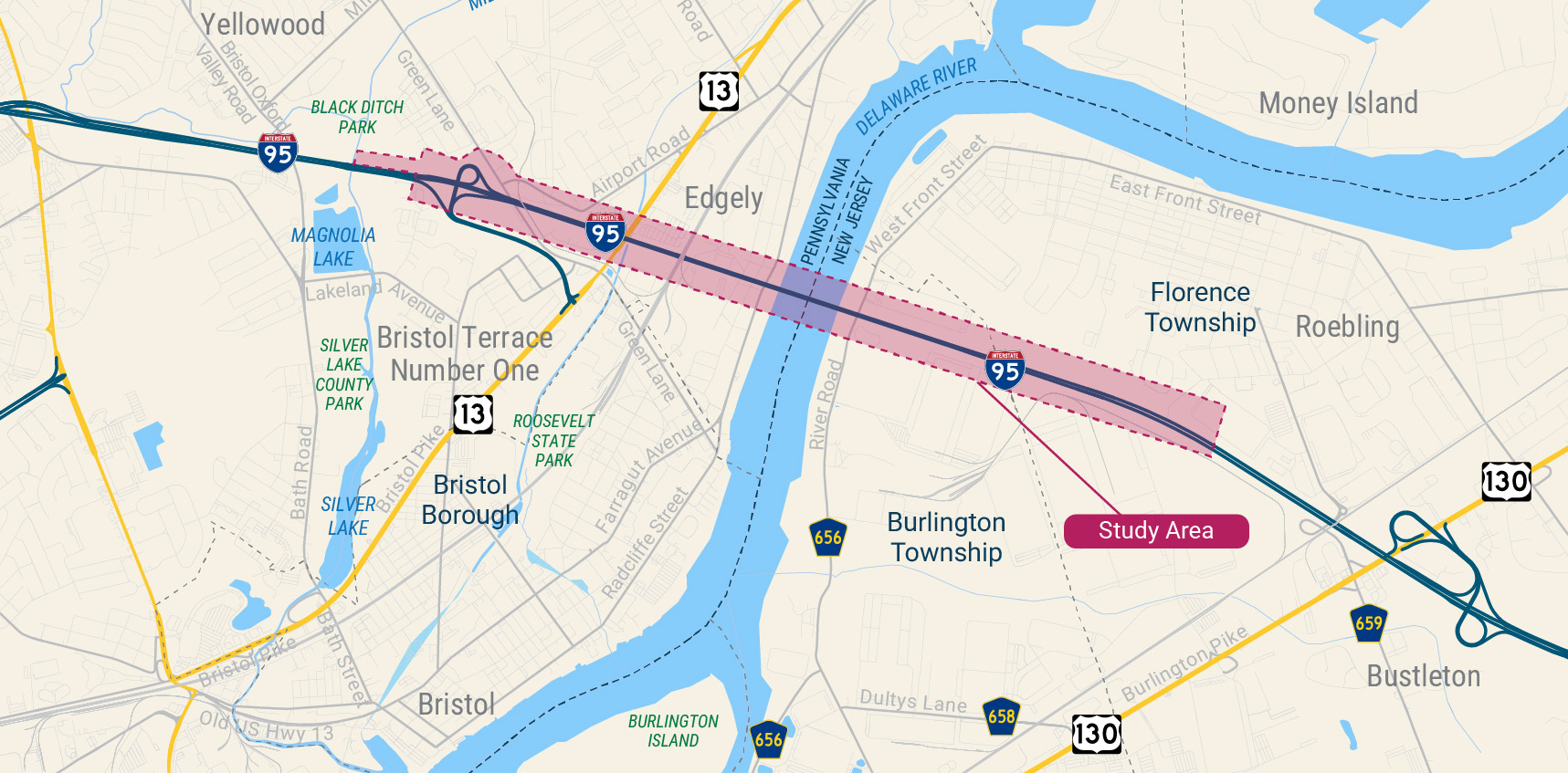
The Pennsylvania Turnpike Commission and the New Jersey Turnpike Authority, with guidance from the Federal Highway Administration (FHWA), are working together to plan the future of the Delaware River Bridge—a critical connection between Pennsylvania and New Jersey. This project is all about improving safety, reliability, and long-term performance for the thousands of drivers who rely on this bridge every day. Not only is it critical to the region’s economic growth, but it is a vital part of the PA Turnpike/I-95 Interchange Project, which directly connects both roadways and makes I-95 continuous along the entire eastern seaboard from Maine to Florida.
Looking Back
In 2003, early planning concepts by the PA Turnpike and the New Jersey Turnpike Authority proposed building a new bridge for traffic heading into New Jersey and upgrade the existing bridge for traffic returning to Pennsylvania. In the years that followed, both the PA Turnpike and the New Jersey Turnpike Authority made improvements on their respective sides of the bridge. During that time, regular use of the bridge and inspections continued, and long-term plans to overhaul the bridge continued to advance.
But in 2017, an unexpected fracture in one of the bridge’s support trusses led to a full closure that lasted over six weeks. The shutdown disrupted travel for nearly 67,000 daily drivers and made it clear that a long-term solution was needed.
Since then, the agencies have set aside funding to thoroughly study all available options. This includes an in-depth Alternatives Analysis, a Supplemental Environmental Impact Statement (SEIS), and early engineering work to explore the best path forward.
Looking Ahead
Today, the project team is reviewing a range of options to replace the bridge. That includes looking at different bridge designs, alignments, and long-term solutions. The goal is to identify the safest, most efficient, and most cost-effective option for the future.
Now that the Alternatives Analysis is complete, preliminary design work will continue through 2028. As part of this process, the SEIS will carefully review how things have changed since 2003, assess potential environmental and community impacts, and include input from federal, state, and local partners, tribes and nations, as well as the public.
When environmental reviews and early engineering are finished, the project will move into the next phase: final design, permitting, and eventually construction.
Stay Connected
Want to stay up to date as the project moves forward? Click here to fill out the contact information form to receive updates and important information.
Project Overview Video
Closed captioning is available in English, Spanish, Mandarin and Russian. To turn on the subtitle captioning of your choice, select the "CC" icon in the bottom right corner of the screen.