

June 2026
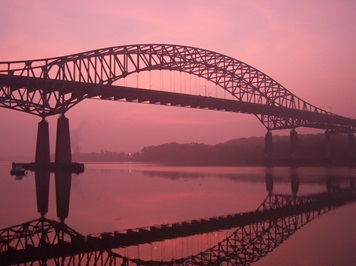
Delaware River Bridge Plans Revealed
The bridge that connects the Keystone State to the Garden State is due for an upgrade, and engineers from the Pennsylvania Turnpike Commission and New Jersey Turnpike Authority revealed the recommended preferred alternative alignment this week for the new Delaware River Bridge.
Engineering Marvel Opens to Traffic
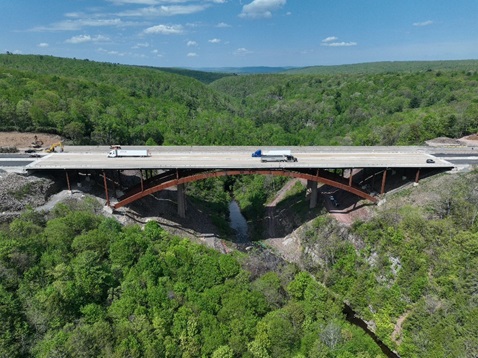
Drivers on the Northeast Extension may not notice as they pass over it, but when viewed from the side or while hiking in the gorge below, the Hawk Falls Bridge is majestic – and built to blend in with the natural surroundings. A ribbon-cutting ceremony officially opened it to traffic recently.

Soccer, Baseball, and One Big Birthday: PA Turnpike Is This Summer’s Hot Spot
Between the World Cup, the All-Star Game, and a celebration of the 250th anniversary or our nation’s founding, summer travel is going to be quite busy on the Pennsylvania Turnpike. Here’s a recap of what’s happening, some of the fun activities at our service plazas in the Philly region.
Delaware River Bridge Plans Revealed
Engineers behind the replacement of a major bridge vital to commerce in the Mid-Atlantic region narrowed their construction options down to the safest, least disruptive, and most cost-effective plan, which they revealed to the public this week.
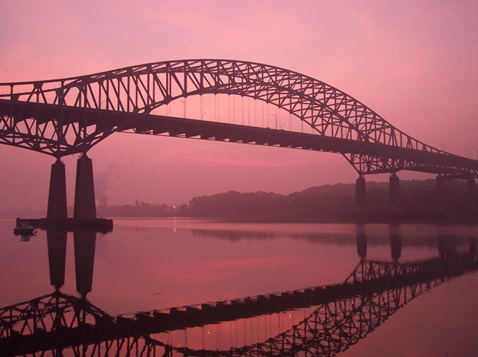
With a series of public meetings that started Tuesday, Pennsylvania Turnpike Commission and New Jersey Turnpike Authority officials are moving forward with the next step of the Delaware River Bridge project.
The Delaware River Bridge Project:
Will improve the crossing of I-95 over the Delaware River to increase capacity, enhance safe travel and ease future congestion.
Is critical to the region's economic vitality as it improves travel for tens of thousands of commuters, travelers and commercial customers a day.
This project is a vital part of the PA Turnpike/Interstate 95 (I-95) Interchange Project, which directly connects both roadways and has made I-95 continuous throughout the Mid-Atlantic.
Of the options that were still on the table for the replacement of the 70-year-old bridge, PA Turnpike and NJTA announced their recommended preferred alternative alignment, which is the North Partial Impact (NPI). Some highlights of this plan include:
Will take less than four years to build, as opposed to eight under the other option dubbed the North Staged Alternate.
Will allow the new bridges to be built in their entirety in one stage, which offers enhanced safety for both construction workers and the traveling public
First, the PA-bound and NJ-bound portions of the new bridge will be built as two separate structures, approximately 195 feet north of the existing bridge’s centerline and about 15 feet from each other.
Then, all traffic will be moved to the new bridges and the current bridge will be demolished.
The new bridge will support six lanes of traffic – an increase from four.
The need for a new Delaware River Bridge was highlighted during a forced closure after crews found a fracture back in 2017. In the time since those repairs, traffic has increased by 60%, Engineer Project Manager John Boyer previously pointed out. Currently, the bridge sees about 68,900 vehicles daily – a number expected to increase to 93,400 by 2050.
The cost of the project is about $1.6 billion, split between both agencies. A $600 million Bridge Investment Program grant is helping to cover the costs.
While NPI is the recommended preferred alternative among the two agencies, they will continue to study the second northern alterative, North Staged Alternate (NSA), throughout the process. The project follows Federal Highway Administration’s National Environmental Policy Act (NEPA) process, and the FHWA will ultimately issue a Record of Decision indicating final alignment.
Public hearings are slated for this winter.
Engineering Marvel Opens to Traffic
You may not notice the Hawk Falls Bridge while you’re driving over it on the Northeast Extension, but when you look at it from another angle – just off to the side or even below while hiking through scenic Carbon County -- the Pennsylvania Turnpike’s new bridge is quite majestic.
It spans a wide valley over Mud Run Gorge, and this $88 million bridge-replacement project at milepost 88.59 was not only built to last while enhancing safety and mobility -- it was built to be a part of the natural landscape. The Hawk Falls Bridge officially opened to traffic earlier this month and was celebrated with a ribbon-cutting ceremony May 26.
The Hawk Falls Bridge in Carbon County opened to traffic last month. About 200 feet in the air and more than 700 feet across, it carries traffic on the Northeast Extension across the Mud Run Gorge.
“Every Pennsylvanian deserves a safe and reliable transportation network and that includes modernized bridges, like Hawk Falls, that improve access and traffic flow, helping motorists arrive at destinations safely and quickly,” Chairman of the Pennsylvania Turnpike Commission and PA Secretary of Transportation Mike Carroll said at the ceremony.
The new bridge supports two lanes of traffic in each direction and increases shoulder and median width. It also reduces long-term maintenance needs and improves longevity by using weathering steel and eliminating expansion joints.
Standing nearly 200 feet above water and surrounded by Hickory Run State Park’s natural beauty, the new steel deck arch bridge replaces the existing steel deck truss bridge and extends 720 feet across Mud Run Gorge. Its 465-foot main span is supported by three arches. To ease future inspections, the new structure’s arch ribs contain nearly 8 miles of wiring, are fully lit and connected to electric and ventilation systems.
“The Hawk Falls Bridge’s uniquely tailored design and construction choices merge environmental, aesthetic and long-term operational needs,” PA Turnpike Chief Engineer Brad Heigel said. “Not only will the bridge enhance the natural beauty of Hickory Run State Park, it will also allow drivers and local first responders more room and places to pull over during emergencies, supporting safer travel along the Pennsylvania Turnpike.”
In addition to fully replacing the Hawk Falls Bridge, the project also reconstructed the nearby Hickory Run Road Bridge in Penn Forest and Kidder Townships.
Read more about the ribbon-cutting ceremony here and watch the video here.
Construction Engineering Manager Alan Williamson was the first to drive across the new bridge with Assistant Chief Engineer of Construction Matt Burd when crews directed traffic from the old bridge to the new one, creating a fine conclusion to a long and unique project.
“Being a part of any project on the Pennsylvania Turnpike is always very special,” Williamson said. “Have that opportunity to be the first car across the bridge going southbound just adds to the value I get out of being a Turnpike employee and Turnpike engineer and building our infrastructure.”
Cutting the ribbon was a great way to close the project but open a new bridge.
Now that traffic is flowing on the new bridge, demolition of the nearby old bridge will begin soon.
Soccer, Baseball, and One Big Birthday: PA Turnpike is This Summer’s Hot Spot
The FIFA World Cup matches in Philadelphia are just part of a busy summer coinciding with the 250th anniversary of the United States, and America’s First Superhighway is celebrating in style at its service plazas.
Stop by for the FIFA fun June 14 through July 4 at the Allentown, King of Prussia, Valley Forge, Peter J. Camiel, and Bowmansville service plazas, where the PA Turnpike will be celebrating the six World Cup matches that will be held in the City of Brotherly Love.
The PA Turnpike’s service plazas around Philly, like this one at King of Prussia, are decked out for a festive summer, celebrating America’s 250th birthday, the FIFA World Cup, and the Major League Baseball All-Star Game.
Also in July, the PA Turnpike will be hosting similar events in the Philadelphia region for the Major League Baseball All-Star Game and is planning activities this summer aligned with America250PA.
These events are similar to the NFL Draft in Pittsburgh events held in April, with activities, promotions, artwork, and more.
But that's not all. If you’re a military veteran and you’re stopping by our service plazas this summer – or any time, really – you can enjoy our new dedicated Veteran Parking Spaces. All 17 service plazas have two spots thanks to this partnership between the PA Turnpike, state Rep. Jennifer O’Mara, the American Legion, and the American Legion Post 329 in Elizabethtown.
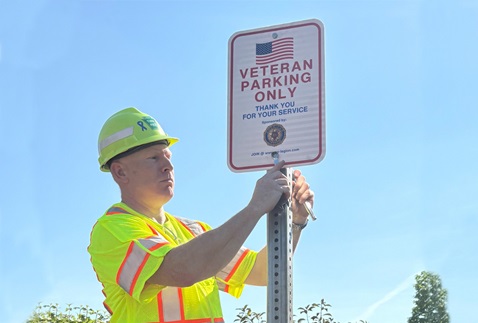
PA Turnpike Maintenance workers install a veteran parking sign at the Valley Forge Service Plaza.
If your travels take you through the central part of the state, be sure to visit the Sideling Hill Service Plaza, where the Sideling Hill Trailhead opened last fall as a place where the highway meets the wilds. From this adventure starting point, travelers have access to more than 600 miles of nearby trails connecting to destinations like the Buchanan State Forest and Raystown Lake. You can even hike or bike The Old PA Pike Trails – a short jaunt away -- to check out the PA Turnpike’s abandoned tunnels, taking in a bit of history.
And if you just want to soak in the rays at the Trailhead itself, you can enjoy the picnic area, a bike wash station, and all of the amenities of the service plaza.
Find out more about the Sideling Hill Trailhead here. You can also learn more by signing up for our Sideling Hill newsletter here.
PA Turnpike, First Responders Work Together to Contain Tunnel Fire
The Pennsylvania Turnpike has seen fires in its tunnels before, but when John DelRicci caught a glimpse of the traffic cameras showing smoke pouring out of the Allegheny Tunnel, he knew this was big.
“I started making phone calls,” DelRicci, the Director of Maintenance for the PA Turnpike, said. “I’ve never seen anything on this magnitude.”
Those calls helped get the right people on the scene, and with the quick actions of the tunnel guards, the Traffic Operations Center, Maintenance crews, first responders, and many others, they safely evacuated about 150 people from roughly 80 vehicles and kept the fire from escalating.
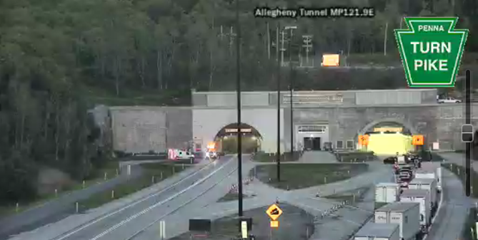
PA Turnpike crews and first responders fought a vehicle fire inside the Allegheny Tunnel on June 4. No major injuries were reported, but 150 people were evacuated from 80 VEHICLES.
The Allegheny Tunnel fire started with a pickup truck hauling a large trailer igniting just before 9 p.m. Thursday in the westbound tube. Four tunnel guards were on duty at the time.
“They got into action,” Tunnel and Field Training Supervisor Todd Porter said. “It was safety first to get our patrons out of the tunnel as it started to grow into a pretty serious situation.”
You can see some images from the news and from those at the scene here and here.
The PA Turnpike closed the tunnel in both directions, allowing fire crews to attack the blaze as tunnel guards turned on the tunnel’s fans, and crews brought in additional fans to help clear the smoke.
Chief Operating Officer Craig Shuey greeted customers evacuated from the tunnel as charter buses the PA Turnpike called in dropped them off at the Kegg Maintenance Facility, where crews provided them with water and other immediate needs.
Meanwhile, at the Traffic Operations Center, Traffic Ops Manager Nathan Keel and Assistant Manager Janice Clea and several additional dispatchers came in to help, more than doubling the nighttime complement to 10 people.
“This is the kind of situation where the room shines,” Clea said. “They’re a well-oiled machine.”
And it all worked out well.

During a tunnel fire on June 4, the PA Turnpike and first responders helped evacuate about 150 people from 80 vehicles.
“We had no catastrophic injuries, and our men and women did an outstanding job,” DelRicci said. “These things happen, and it’s training, training, training that helps us succeed and get the job done.”
Shuey is proud of the work of all involved and impressed by the way the PA Turnpike and first responders came together, formulated a plan, and executed that plan safely. It was especially challenging considering how remote the tunnel is, located on a 36-mile stretch between the Somerset and Bedford interchanges.
And it’s an area that is no stranger to major incidents.
“The experience of Jonas came into play in understanding the challenges of the tunnel,” Shuey said, referencing the major winter storm of a decade ago -- and the lessons learned from those days that contributed to the successful response to the fire. “It strengthened our resiliency and our resolve.”
Customers returned to their vehicles just before 3 a.m. The eastbound tube reopened around that time, allowing traffic to pass in both directions until cleanup efforts wrapped up in the westbound tube the following day.
“I’m very pleased with the response we had from our employees at the tunnel,” Porter added. “They went into training mode and safety mode. That’s our number one rule – keep the public safe.”
PA Turnpike officials are in the preliminary engineering phase of the Allegheny Mountain Realignment Project to bypass the tunnel. This bypass will address some of the unique safety and incident-response challenges associated with the Allegheny Mountain Tunnel area, creating a safer, smoother and more reliable stretch of roadway. Read all about it in last month’s The Road Ahead.