

October 2026
Report details what went well, what to improve in response to Allegheny Tunnel truck fire
About 150 people were safely evacuated after a truck caught on fire inside the Allegheny Tunnel, but there were some lessons to be learned. PA Turnpike officials released an after-action report this month, detailing what went well, what can be improved, and what steps have already been taken.
Solar Canopy installation nearly complete at PA Turnpike’s Central Administration Building
Electric vehicles parked at the Pennsylvania Turnpike’s central office will soon have a place to park that’s protected from the elements – and they can recharge their batteries at the same time. It’s the new solar canopy.
Report details what went well, what to improve in response to Allegheny Tunnel truck fire
Even though all travelers were evacuated safely and the Allegheny Tunnel reopened within a day of a pickup truck fire inside, the PA Turnpike and emergency responders still identified a few lessons for future response.
The PA Turnpike released an after-action review of the June 4 fire to build upon what worked and turn those lessons into actions to strengthen emergency response and customer and responder safety in the future.
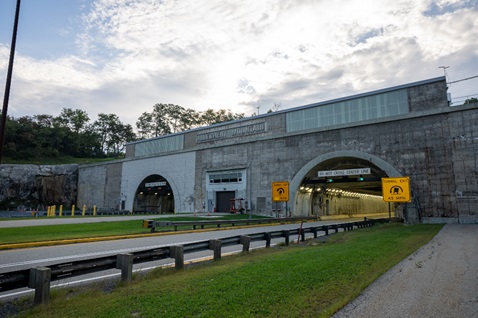
The Allegheny Tunnel is located between the Somerset and Bedford interchanges.
PHOTO: Allegheny Tunnel. Cutline: The Allegheny Tunnel is located between the Somerset and Bedford interchanges.
“We are grateful to the firefighters and first responders, not only for their bravery and support throughout the event to ensure the safety of motorists, but for their collaboration and expertise following the incident,” said PA Turnpike CEO Mark Compton. “Continuous improvement is fundamental to how we operate, and collaboration between our partners who support the roadway during key emergency incidents is critical to delivering our mission to provide a safe and reliable toll road for our customers.”
A pickup truck hauling a trailer caught on fire around 8 p.m. that evening in the westbound tube of the mile-long tunnel, creating a complex emergency response scene in a challenging environment with heavy smoke filling the confined space.
"Tunnel emergencies present safety challenges that are fundamentally different from incidents on an open roadway,” said PA Turnpike COO Craig Shuey. “That is why ongoing training, preparation and learning from an incident like this are so important to the safety of our customers and responders.”
The 19-page report identified areas that worked during the response and areas that can be improved, such as:
In-tunnel communications
Ventilation and smoke management
Evacuation procedures
Incident command and responder readiness
And traffic recovery operations
Solar Canopy Installation Nearly Complete at PA Turnpike’s Central Administration Building
Electric vehicles parked at the Pennsylvania Turnpike’s central office will soon have a place to park that’s protected from the elements – and they can recharge their batteries at the same time.
And as a bonus, the 15-foot solar canopy in the parking lot at the Central Administration Building in Middletown is powered by the sun.
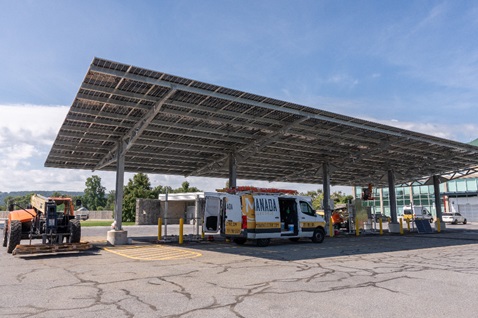
The new solar canopy at the Central Administration Building near Middletown will help harness the power of the sun to charge the electric vehicles parked underneath.
“As we drive toward becoming America’s First Sustainable Superhighway, we are excited to invest in renewable, clean energy right here in Dauphin County,” said PA Turnpike Commission CEO Mark Compton. “For 85 years and counting, we’ve been at the forefront of transportation innovation. Creating a sustainable future is the right thing to do – for our customers, our financial partners and the entire Commonwealth.”
The canopy holds 186 solar panels, powering charging stations for 20 electric vehicles. The canopy is expected to generate 136,400 kilowatt-hours of electricity in its first year – the equivalent of an electric car driving the length of the PA Turnpike more than 750 times.
Funded by non-toll revenue generated from other solar projects, the solar canopy and the newly installed 537 solar panels on the central-office roof represent a $2.2 million investment with an approximate 10-year return on investment. Excess energy will be sold back to PPL Electric, the Commission’s energy provider.
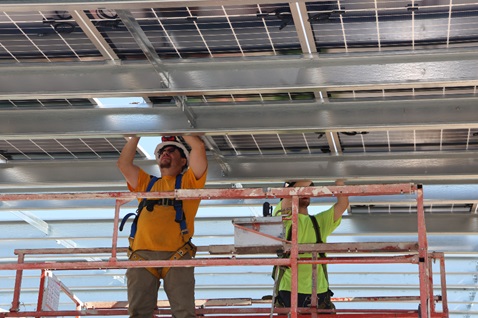
Crews install the solar canopy at the PA Turnpike’s Central Administration Building.
The solar canopy will eventually power the PA Turnpike’s planned Stationary Inductive Charging Showcase, which will be a proving ground for in-road EV charging, with the long-term goal of introducing the technology along the Mon/Fayette Expressway. In January, the PA Turnpike selected Electreon Wireless to install three charging pads that will be powered by a solar canopy. That project will begin in 2027. will be powered by a solar canopy. That project will begin in 2027.
“This project is the backbone of the PA Turnpike’s inductive charging strategy to create the next generation of highway travel,” said Keith Jack, Assistant Chief of Facilities Operations and former chair of the PA Turnpike Commission’s Sustainability Committee. “It will help us deliver EV charging accessibility to our fleet and provide the tools and knowledge necessary to incorporate additional emerging technologies into our roadway.”
The PA Turnpike has several other solar projects under its belt. Last year, crews built a solar microgrid at its Western Regional Office that will power the PA Turnpike’s 27,000-square-foot office, as well as the Pennsylvania State Police Troop T New Stanton barracks. The microgrid, which operates in conjunction with a natural-gas generator as a backup, is the second of its kind that the Commission has built.
The first came online in 2021 at the Greensburg Maintenance Facility in Hempfield Township, Westmoreland County. A tolling industry first, the array of 3,224 (405 watt) solar panels generates 1.305 megawatts of power. Alongside a continuous, 1.2 megawatt natural-gas generator, the microgrid is projected to yield $450,000 in annual savings, a new revenue stream and eventual energy independence.