

August 2026
.tmb-2_column.png?sfvrsn=c408d24_1 "mark headshot (1)")
PA Turnpike Drives Economic Growth Through Accessibility: A Message from the CEO
While traffic volumes are the foundation of our operations and revenue, the impact of the Pennsylvania Turnpike Commission goes far beyond moving vehicles. We have played a pivotal role in unlocking real estate potential and spurring development throughout the Commonwealth.
Electric Vehicle Fast Chargers Coming to All PA Turnpike Service Plazas
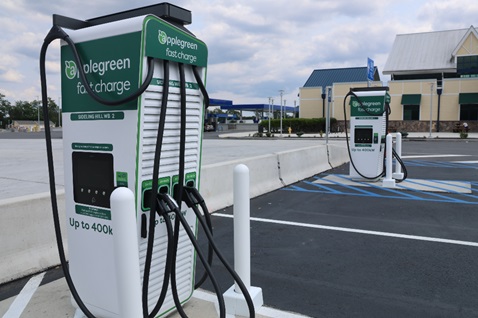
If you’re driving an electric vehicle from one end of the PA Turnpike to the other, you don’t have to worry about finding a place to recharge. Several new fast chargers were added in the last couple of weeks, with the rest to be installed soon.
Open Road Tolling One Step Closer to Going Live Across Entire PA Turnpike
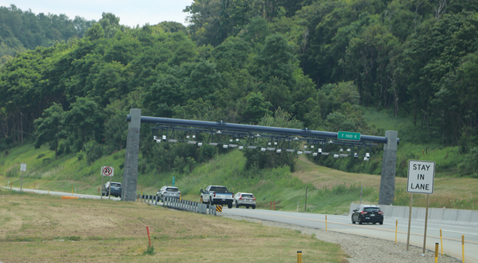
The best infrastructure is often the infrastructure you never notice. Drivers pass beneath an Open Road Tolling gantry in seconds, but there are hundreds of pieces of equipment working together to make that trip as seamless as possible.
Driving Economic Growth Through Pennsylvania Turnpike Accessibility
By Mark Compton, CEO, The Pennsylvania Turnpike Commission
.tmb-3_column.png?sfvrsn=98d97a38_1 "mark headshot (1)")
While traffic volumes are the foundation of our operations and revenue, the impact of the Pennsylvania Turnpike Commission goes far beyond moving vehicles. The Pennsylvania Turnpike has played a pivotal role in unlocking real estate potential and spurring development throughout the Commonwealth, supporting local economies through improved accessibility and strategic investment.
Since opening in 1940, the Pennsylvania Turnpike has served as a critical corridor for commerce and connectivity.
Businesses have long depended on it for the efficient transportation of goods, while residents enjoy improved access to employment and services. The PA Turnpike facilitates greater connectivity to towns and communities and aligns with the Commonwealth’s priorities for tourism and outdoor recreation.
The PA Turnpike’s Historic Role in Economic Development
Communities with PA Turnpike interchanges have consistently seen stronger economic performance, as improved accessibility influences site selection for manufacturing facilities, distribution centers and service businesses that support them. The Pennsylvania Turnpike Commission’s role is to support the communities’ vision where we can, while communities lead the way in shaping their own economic future.
In 1954, local newspapers attributed northern Lancaster County’s “business boom” to the roadway’s Eastern Expansion four years earlier. Nine businesses, including hotels, service stations and a diner, sprung up within half a mile of the Reading interchange.
The Southern Beltway in western Pennsylvania is a more recent example. Fifteen years after its initial segment – the Findlay Connector – opened in 2006, and just over five years since its final link connected the PA Turnpike to Interstate 79, the corridor has delivered more than 4 million square feet of development and a growing tax base for Allegheny County, Findlay Township, and West Allegheny schools. This is infrastructure investment translating directly into economic opportunity.
Chester County’s State Route 29 Interchange, completed in 2012, is another successful roadway-adjacent development. By providing a direct connection to a large industrial complex in suburban Philadelphia, the interchange catalyzed significant growth. Studies link it to the creation of 10,000 new jobs, $1 billion in total labor income, $3.5 billion in total economic output, and $30 million in new state and local tax revenue. These numbers underscore the transformative power of strategic infrastructure investment.
Similar stories continue to unfold along the roadway. In Breezewood and along Westmoreland County’s State Route 130, planned realignments and new Open Road Tolling-enabled interchanges are expected to enhance connectivity and spur regional development. These projects reflect a broader trend: when counties and the PA Turnpike Commission collaborate to improve access, the economic ripple effects are substantial.
Open Road Tolling: A Game-Changer for Connectivity
One key aspect of collaborative, access-driven economic impact comes via Open Road Tolling (ORT). You can read about that in this edition of The Road Ahead.
These new access points can be built at a fraction of the cost and in significantly less time than traditional toll plazas, delivering greater economic and mobility benefits to adjacent communities.
ORT launched east of Reading and along the entire Northeast Extension in January 2025 and will expand westward in early 2027. As this transition unfolds, communities across Pennsylvania will have unprecedented opportunities to leverage roadway access for economic development.
The Pennsylvania Turnpike Commission’s Capital Plan commits $8 billion to transportation investment over the next decade, with approximately 75% dedicated to construction projects. These investments are funded entirely through toll revenue – not state or federal tax dollars – ensuring that every dollar collected translates into tangible improvements in safety, mobility, and economic opportunity.
Beyond ORT, initiatives like the Total Reconstruction Program are rebuilding the PA Turnpike from the ground up, widening lanes, smoothing curves, and enhancing emergency access. Projects such as the $269 million Beaver River Bridge replacement in Beaver County exemplify the commitment to modern standards that support safety and economic vitality.
For community leaders, the implications are clear: transportation infrastructure is a cornerstone of economic development. Improved PA Turnpike access attracts employers, supports housing growth, and strengthens tax bases. It also positions counties to compete in a regional and global economy where connectivity is key.
As ORT expands, communities have an opportunity to reimagine their economic future. By partnering with the PA Turnpike Commission, local governments can identify strategic access points that unlock development potential, reduce congestion, and enhance quality of life for residents.
The Pennsylvania Turnpike is more than a roadway – it is an economic engine driving the Commonwealth forward. With ORT and our long-term capital investments, we are creating a transportation system that meets modern demands while fueling growth for decades to come.
Electric Vehicle Fast Chargers Coming to All PA Turnpike Service Plazas
Drivers with electric vehicles can quickly recharge their batteries and get back on the road again while traveling the Pennsylvania Turnpike.
It’s all thanks to the new Applegreen Electric EV Fast Chargers, which went live at the Sideling Hill and Lawn service plazas this month, with more expected to come online soon.
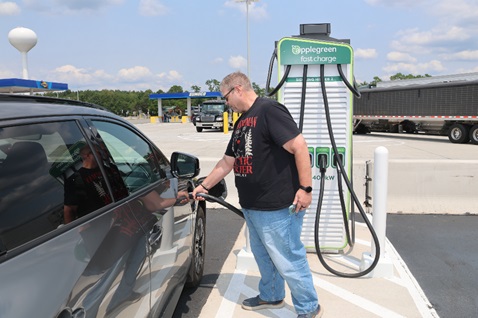
A PA Turnpike customer recharges his EV at one of the new fast chargers at the Sideling Hill Service Plaza.
“Our overall goal is to provide our customers with a seamless travel experience,” said Service Plaza Operations Manager Michelle Tressler. “They can go into the service plaza while their vehicle is charging to relax and take a safety and meal break.”
A total of 68 charging ports – with two ports per charger – are expected to be installed at all 17 of the PA Turnpike’s service plazas by spring. The fast chargers have CCS plugs for most EVs and NACS plugs for Teslas and can charge an EV in about 20 minutes. The service plazas also have 64 Tesla chargers and one Blink charger. The Blink charger is expected to be removed soon, so by next year, the PA Turnpike will have a total of 132 EV charger ports.
Fast chargers can currently be found at these service plazas (from west to east):
- New Stanton
- North Somerset
- South Somerset
- South Midway
- Sideling Hill
- Blue Mountain
- Lawn
- Bowmansville
More are opening by the end of the year at:
- Oakmont-Plum
- North Midway
- Cumberland Valley
- Highspire
- Allentown
- Valley Forge
- King of Prussia
- Peter J. Camiel
Applegreen Electric pays a rental fee and a portion of the funds from each charger goes to the PA Turnpike Commission, as well. It serves as a source of non-toll revenue, a number which is expected to grow in the coming years.
Assistant Chief of Facilities Operations Keith Jack has long championed all things sustainable, and he is pleased to see more and more customers driving EVs and using the PA Turnpike’s new fast chargers. The number has grown since the first generation of chargers were installed more than a decade ago.
That’s a good thing as the PA Turnpike strives to become America’s First Sustainable Superhighway by 2040 – and it’s far from the end of the story.
“We’re just getting started,” Jack said. “The next conversation is ‘Where is the power coming from?’”
The PA Turnpike already has a solar microgrid at the Greensburg Maintenance Facility and one to open soon at the Western Regional Office near New Stanton to power those facilities, and Jack said talks are underway to build more near some service plazas to generate power for EV chargers and more.
The EV chargers have been well received by customers, Jack said, and the PA Turnpike will continue to evolve to meet the needs of travelers and keep them moving on the PA Turnpike.
Open Road Tolling One Step Closer to Going Live Across Entire PA Turnpike
By Olivia Collins, Summer Communications Intern
The best infrastructure is often the infrastructure you never notice.
Drivers pass beneath an Open Road Tolling (ORT) gantry in seconds, rarely considering the hundreds of pieces of equipment working together to make that seamless trip possible. Behind that effortless experience is an extensive amount of work, from installation, testing, and coordinating the efforts of teams across the Pennsylvania Turnpike.
The Open Road Tolling gantries near the Allegheny Tunnel are undergoing equipment installation. They are unique gantries with one over the PA Turnpike in each direction instead of one gantry over both the eastbound and westbound lanes due to the wide distance between the lanes along the mountainous terrain.
As work continues on the Commission's ORT expansion into central and western Pennsylvania, installation remains on schedule for a January 2027 opening.
According to Matthew McConnell, Manager of Toll Systems Technologies, roadway loop installation has been completed at all 19 sites, while overhead equipment installation, equipment shelter construction and site finalization have been completed at 11 locations between the Ohio line and Somerset.
Work at the remaining sites continues on schedule, bringing the Commission one step closer to a fully modernized toll collection system designed to improve reliability, operational visibility and long-term performance.
Depending on the size of the location, installing, configuring, testing and commissioning a single ORT site typically takes five to six weeks. During that time, crews install more than 200 individual pieces of equipment, including high-speed cameras, E-ZPass readers, vehicle detection sensors, fiber optic communications and computing equipment.
"Every component must work together as one integrated system," McConnell said. "All of these systems operate together in a matter of milliseconds as vehicles travel through the gantry at highway speeds to produce our toll transaction."
Installation, however, is only part of the process. Before a site goes live, extensive testing verifies that every component performs exactly as intended.
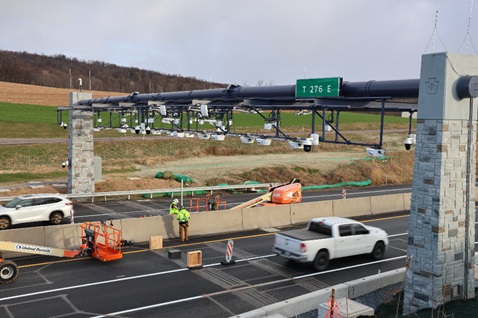
Crews install tolling equipment on the gantry just west of Reading. This was the first gantry in the second phase of Open Road Tolling to be equipped and tested.
"Every vehicle passing beneath a gantry must be identified correctly so customers are charged appropriately," McConnell said. "Even small issues, such as a camera that is slightly misaligned or a communications delay, can affect image quality, transaction processing or system performance."
Achieving that level of accuracy requires more than sophisticated technology.
McConnell said one of the greatest successes of the project has been the collaboration across the organization, noting that nearly every department has played a role in bringing ORT to life. Together with contractors and tolling partners, employees have built more than infrastructure -- they've created the technology foundation that will support millions of customer transactions for years to come.
By 2027, once ORT is operational across the Pennsylvania Turnpike mainline, the system is expected to capture between 3.5 and 4.5 billion vehicle images each year to support toll transactions. When drivers pass beneath a gantry without giving the technology behind it a second thought, McConnell says that's a sign the system is working exactly as intended.